
Legal CommentaryCommentary
The Constitutional Auditor Rule Book
Recording rights and the economics of municipal settlements
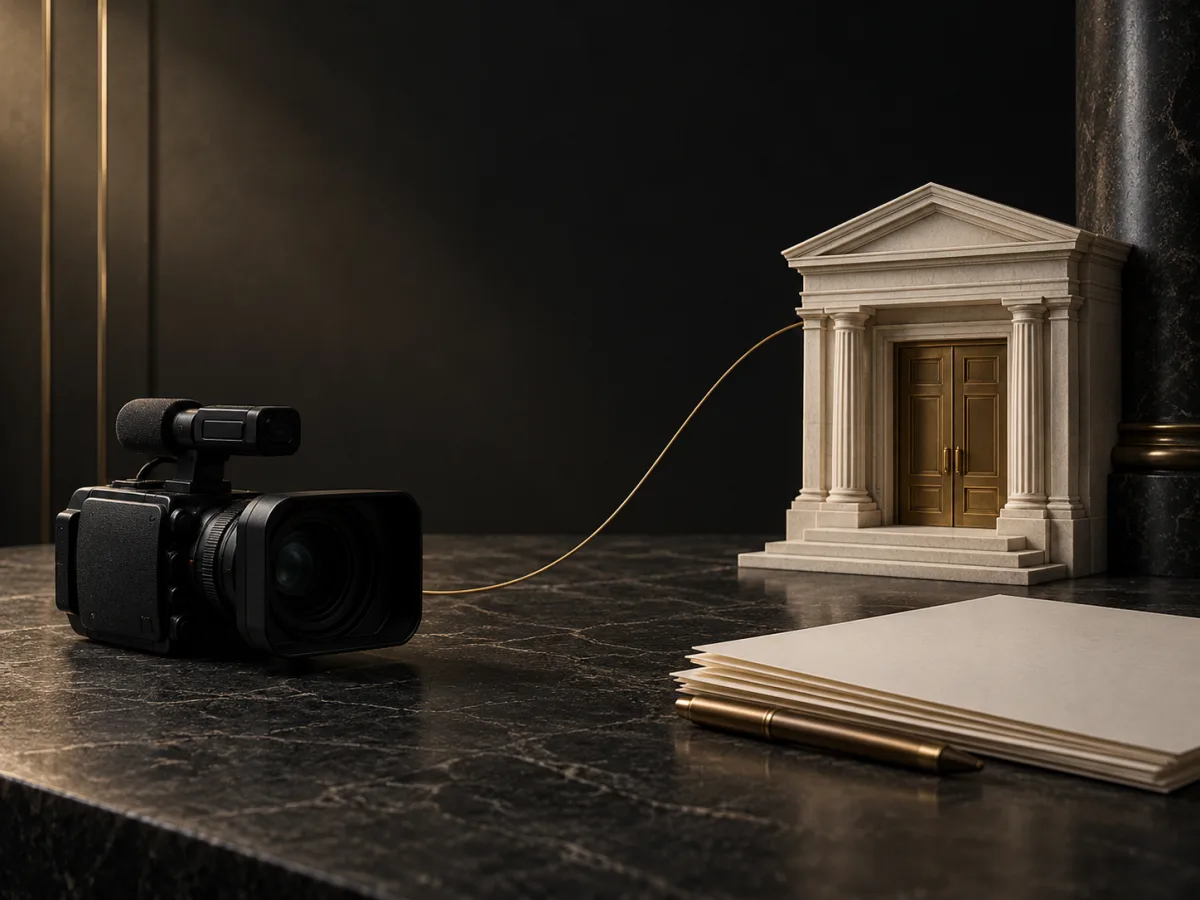
Commentary: This article presents the author’s views and arguments. It is not advice about a particular case.
A person arrives at a government office carrying a camera. Employees ask questions. The person announces that filming is a constitutional right. An argument develops, police arrive, and the encounter becomes a YouTube video. Sometimes a demand letter or lawsuit follows.
The stated purpose may be educating the public about constitutional rights. My concern is whether, in some encounters, the desired product is the confrontation itself: a video that attracts viewers and an incident that might produce a settlement.
The question is how constitutional protection, audience revenue, and settlement pressure interact. This rule book examines the recording rights, the requirements for a claim, and the reasons a municipality might pay even when it believes it could win.
Rule one the label does not establish the motive
“Constitutional auditor” is a self-description, not a government credential. It proves neither educational intent nor a plan to manufacture claims.
An individual can have mixed motives: exposing misconduct, attracting an audience, earning advertising revenue, and seeking compensation for a real violation. Commercial ambition does not automatically eliminate constitutional protection.
To assess a particular person’s conduct, examine complete recordings, statements, litigation history, and actual outcomes. Edited clips and an observer’s suspicion do not establish that a lawsuit was the sole purpose of the visit.
Rule two there is a real right to record
In Smith v. City of Cumming, the Eleventh Circuit recognized a First Amendment right to photograph or videotape police conduct, subject to reasonable time, place, and manner restrictions. Importantly, the plaintiffs nevertheless lost because they had not shown that the defendants violated that right. A right and a successful claim are separate questions. [1]
In Glik v. Cunniffe, the First Circuit allowed claims to proceed arising from an arrest for recording police on Boston Common. The alleged recording was peaceful and did not interfere with police work. That decision is persuasive outside that circuit, rather than controlling Florida authority. [2]
Fields v. City of Philadelphia, a Third Circuit case, rejected a requirement that the recorder demonstrate an expressive purpose at the moment of filming. It recognized protection for recording public police activity, while granting the individual officers qualified immunity based on the law when those events occurred. [3]
Recording has a recognized public purpose: preserving evidence of government conduct so accounts can be tested rather than simply accepted. That purpose can benefit the public and officials falsely accused of misconduct. Whether a particular video accomplishes anything useful is an editorial judgment; it is not the sole test of constitutional protection.
Rule three public ownership does not mean unlimited access
A public sidewalk, an active emergency scene, a city council meeting, and an employee’s office are not interchangeable places. Public ownership alone does not make every room a forum for unrestricted filming. Nonpublic forums can have reasonable, viewpoint-neutral restrictions consistent with their function.
Crocker v. Beatty illustrates the limits of general recording principles. The Eleventh Circuit granted qualified immunity on a First Amendment claim involving photographs taken from an interstate median near a crash scene. It did not recognize a general right to record from any government-owned location. [4]
Punta Gorda litigation supplies more direct examples involving buildings. In Sheets v. City of Punta Gorda, a federal district court denied a preliminary injunction against a consent-based recording ordinance in 2019. That was a ruling on preliminary relief and its record, not a nationwide ban on recording government employees. [5]
In May 2026, an unpublished Eleventh Circuit opinion in Sheets v. Jimenez affirmed dismissal of claims arising from enforcement of Punta Gorda’s ordinance. An unpublished decision is persuasive rather than binding circuit precedent. The result nevertheless demonstrates that an auditor can lose. [6]
These defenses depend on the location, actual policy, constitutional validity, and manner of enforcement. Selectively excluding critics can create the very liability a restriction was intended to avoid.
Rule four a camera does not excuse an independent offense
Recording does not confer permission to trespass on private premises, enter restricted areas, threaten people, or obstruct lawful operations. A private bank or business generally can withdraw permission to remain, subject to applicable law. Filming from a public sidewalk presents different issues.
Florida’s disorderly-conduct statute cannot be treated as a catchall for uncomfortable employees or angry bystanders. State v. Saunders requires more than mere annoyance and limits punishment of speech. United States v. Lyons distinguishes speech alone from additional conduct that can support probable cause. [7]
“Someone complained” does not automatically supply an offense. Equally, “I am exercising my rights” does not automatically defeat a charge supported by actual unlawful conduct. The record must show which occurred.
Rule five touching the camera can create a different claim
The well-known plate case is Fisher v. Carrousel Motor Hotel, Inc., decided by the Texas Supreme Court in 1967. A hotel employee forcibly removed a Black guest’s dinner plate while refusing service in a racially humiliating encounter. The court held that offensive contact with an object closely identified with the person could constitute civil battery without direct bodily contact. It reinstated the jury’s actual and exemplary damages totaling $900. [8]
That principle can inform an analogy to forcibly snatching a camera held in someone’s hand. Fisher is Texas authority, not a Florida camera decision. Florida’s Supreme Court also recognizes that contact with something sufficiently connected to a person can satisfy the touching requirement in appropriate circumstances; Clark v. State examined that connection in a vehicle collision. [9]
It is too broad to say every touch of a camera is battery. Intent, harmful or offensive contact, connection to the person, consent, and any legal privilege must be examined. Accidental contact or touching unattended equipment presents a different question. Florida’s criminal battery statute also has its own elements. A civil battery claim is not itself a criminal conviction. [10]
A citizen facing a supported claim may settle or contest liability and damages. Collectability also matters. A demand citing Fisher does not establish liability, but irritation at filming is ordinarily a poor reason to grab someone’s equipment.
Rule six a demand letter is a claim rather than a judgment
Where an actual violation is alleged, the sequence may begin with a demand explaining the encounter, legal theory, supporting evidence, claimed damages, and requested resolution. A defendant or insurer investigates and may negotiate, reject the demand, or request further information.
If no resolution follows, a supported lawsuit may be filed. A federal civil-rights complaint must identify a deprivation of federal rights under color of state law and the basis for each defendant’s liability. Pleading, motions, discovery, mediation, and potentially trial follow. A camera does not bypass those stages.
A demand should not imply that an arrest, employee complaint, or clipped video conclusively establishes a constitutional violation. The complete recording, body-camera footage, actual restrictions, and sequence of events may change the analysis. Fabricated evidence and unsupported claims create exposure to sanctions; losing a genuinely disputed case does not by itself make the case frivolous. [11]
There is also no universal municipal fund that an auditor becomes entitled to collect. Payment authority, insurance, self-insured retention, approval procedures, and available appropriations vary. “Discretionary litigation funding” should not be confused with third-party funding of lawsuits.
Rule seven the city is not automatically liable for its employee
Under Monell, a municipality is not liable under section 1983 merely because it employed the person who committed the alleged wrong. The claimant must connect a constitutional deprivation to municipal policy, custom, or another legally sufficient basis, such as an act attributable to a final policymaker. [12]
An inadequate-training theory likewise requires more than saying an employee made a mistake. The necessary facts and deliberate-indifference standard must be satisfied. The city’s potential liability and an individual officer’s liability require separate analysis.
Qualified immunity may protect an individual officer from damages when the governing right was not clearly established in the relevant circumstances, assuming the defense otherwise applies. Municipalities themselves do not receive qualified immunity. A plaintiff therefore cannot assume the city pays whenever an officer is named, and a city cannot assume an officer’s immunity automatically resolves its own exposure.
A federal civil-rights suit against an ordinary private citizen is generally unavailable without the required state action. A camera-snatching dispute between private individuals ordinarily presents state tort questions instead.
Rule eight defense costs create leverage but damages still matter
A city may decide that a negotiated payment costs less than investigation, discovery, depositions, motions, and trial. Civil-rights fee shifting can increase exposure: section 1988 permits a reasonable attorney-fee award to qualifying prevailing parties. Those fees belong in the case economics, not automatically in the claimant’s personal income. [13]
A small damages claim can carry substantial fee exposure. However, Farrar v. Hobby shows that limited success can justify no attorney-fee award in appropriate circumstances. A nominal victory does not guarantee a large fee award. [14]
CIRSA, a municipal risk pool, reported a $41,000 settlement of an auditor’s wrongful-detention claim in Colorado Springs in 2018. That is a reported settlement, not a measure of the recipient’s net income or a typical payment per encounter. [15]
A settlement can reflect strong liability, uncertainty, defense costs, or a combination. Payment alone does not tell us which factor controlled.
What would two thousand hours earn
Forty hours a week for fifty weeks is 2,000 hours. That schedule does not establish likely earnings. There is no reliable conversion rate here from encounters to viable claims, settlements, or cash received within a year.
The table illustrates three hypothetical outcomes, assuming a one-third contingency fee on every recovery and payment within the year. Settlement amounts and expense allowances are assumptions, not industry averages. Taxes and video income are excluded.
| Assumed receipts | Gross | Legal fee | Other costs | Net before tax |
|---|---|---|---|---|
| None | $0 | $0 | $5,000 | −$5,000 |
| Two payments of $10,000 | $20,000 | $6,667 | $5,000 | $8,333 |
| Four payments of $25,000 | $100,000 | $33,333 | $10,000 | $56,667 |
Across 2,000 hours, those hypothetical net amounts equate to approximately −$2.50, $4.17, and $28.33 per hour. Delayed payments could leave the current year negative. YouTube revenue requires a separate analysis of audience, monetization, and expenses.
What municipalities should examine before paying
First, determine whether there was a violation at all. Review the full recording and applicable law. A reasonable restriction in the correct forum, enforced without viewpoint discrimination, can be a substantive defense. An annoyance-based justification for suppressing lawful recording may not be.
Second, separate defendants and claims. Require a properly supported Monell theory against the city; evaluate qualified immunity for individual officers; examine the specific elements of retaliation, unreasonable seizure, and any state tort. Probable cause can be important to a retaliatory-arrest defense, but exceptions and the precise claim matter.
Third, scrutinize causation and damages. Distinguish actual injury from unsupported descriptions of humiliation, lost income, or reputational harm. Evaluate nominal damages and realistic fee exposure instead of assuming the demand amount is the case value.
Fourth, examine whether an exclusion creates a separate due-process problem. In Sheets v. Davoult, an April 2026 district court order dismissed First Amendment theories but allowed a municipal procedural-due-process claim concerning a year-long ban to proceed. A lawful initial removal does not necessarily justify a long exclusion without a meaningful challenge procedure. [16]
Fifth, consider a focused early motion where appropriate and compare its expense with settlement. Sanctions and defense fee recovery have standards; they are not automatic remedies against a frequent litigant. Evidence matters more than the label “auditor.”
Whether cities overlook these defenses requires examination of specific claims, settlement records, and decision-makers’ explanations. A defensible case can still be expensive enough to settle. Equally, a city can spend heavily defending conduct it should have prevented.
The strongest practical response is often lawful conduct at the outset: clear rules, trained staff, measured enforcement, complete documentation, and no retaliatory equipment-grabbing. That reduces the number of genuine claims without sacrificing protected public oversight.
When confrontation becomes a business
I find deliberately cultivating confrontations for settlement money distasteful. Public employees should be able to serve residents without becoming unwilling performers in someone else’s content business. Taxpayers should not have to finance needless conflict.
Recording government conduct serves a legitimate purpose. The problem is treating conflict as the product: an encounter designed to generate attention and, potentially, a demand for money.
That motive must be established from the evidence. Some recordings expose genuine misconduct. Others may reveal a person more interested in escalating the exchange than obtaining information. The full encounter matters more than either side’s preferred description.
Municipalities should understand their defenses and avoid paying merely because someone has a camera and a demand letter. They should also recognize conduct that creates real liability. Clear rules, consistent enforcement, and restraint protect both public operations and constitutional rights.
This article is legal commentary, principally concerning Florida and federal law. Case outcomes depend on the facts, jurisdiction, applicable law, and procedural posture. The earnings illustration is hypothetical.
Sources
- Smith v City of Cumming 212 F3d 1332 2000
- Glik v Cunniffe 655 F3d 78 2011
- Fields v City of Philadelphia 862 F3d 353 2017
- Crocker v Beatty published Eleventh Circuit opinion 2021
- Sheets v City of Punta Gorda preliminary injunction order 2019
- Sheets v Jimenez unpublished opinion May 29 2026
- State v Saunders and United States v Lyons
- Fisher v Carrousel Motor Hotel 424 SW2d 627 1967
- Clark v State Florida Supreme Court February 8 2001
- Florida Statutes section 784.03
- Federal Rule of Civil Procedure 11
- Monell v Department of Social Services 436 US 658
- 42 USC section 1988
- Farrar v Hobby 506 US 103
- CIRSA municipal risk pool discussion of auditor settlement
- Sheets v Davoult district court order April 21 2026